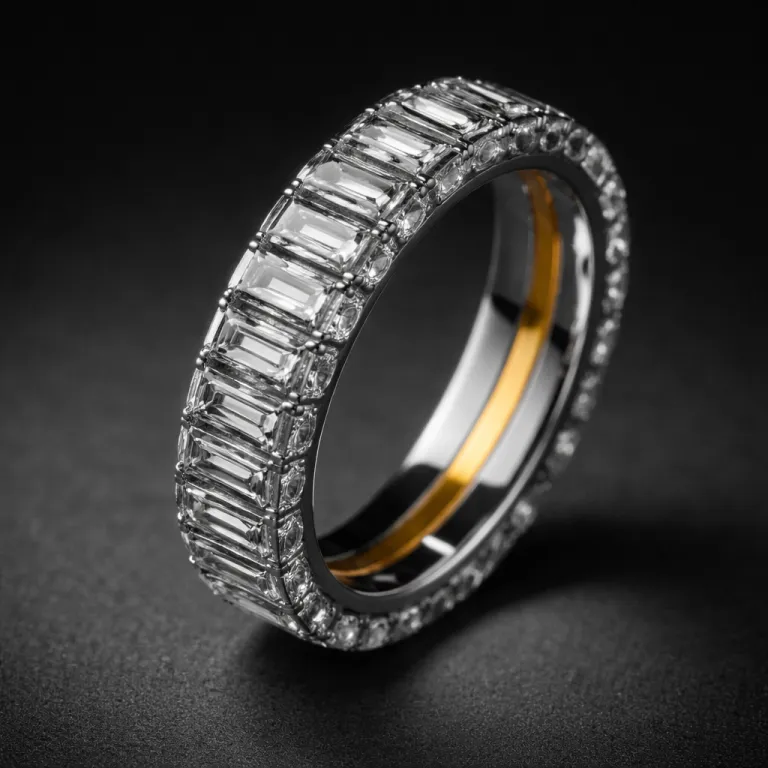
What mystery and invisible settings really are beneath the surface
Mystery setting and invisible setting jewelry look impossibly smooth to the eye. In both cases the stones appear to float, with no visible prongs or beads, yet every piece of jewelry is mechanically locked into a hidden metal grid beneath the surface. That grid is the secret language of this setting technique, and understanding it changes how you see high jewelry pieces forever.
In a true invisible setting, each gemstone is cut with tiny grooves along the pavilion that slide onto parallel rails of metal, so the stones sit shoulder to shoulder and the gold or platinum disappears from view. The setter must align every invisibly set stone so the table is perfectly level, the girdles do not chip, and the light can still travel through the diamonds or colored gemstones without obstruction. When several invisible settings are combined into one piece of jewelry, the result is a continuous field of color that feels like poured light rather than assembled stones.
Van Cleef & Arpels transformed this invisible setting technique into the proprietary Serti Mystérieux, the archetypal mystery setting that serious collectors reference. Under the Van Cleef & Arpels mystery system, the rails are often curved or articulated, allowing the mystery-set rubies, sapphires, or emeralds to follow the contour of a leaf, bow, or ribbon without breaking the surface pattern. This is why a single mystery-set piece from Van Cleef & Arpels, especially in white gold or yellow gold, can take hundreds of hours at the bench and still feel weightless on the wrist.
Why this setting technique is harder than pavé by an order of magnitude
Most owners know pavé and micro pavé, where small diamonds are held by tiny prongs raised from the metal surface. Invisible settings and mystery settings reverse that logic, hiding the metal and exposing only the stones, which leaves no margin for error. A single misaligned groove or over-polished girdle can cause an entire row of invisibly set stones to loosen, something no responsible atelier will accept.
Training a bench jeweler to execute a stable invisible setting usually takes many years of focused work on simpler set pieces first. A setter might spend a decade perfecting channel setting, calibré cuts, and traditional pavé before being trusted with a mystery-set panel that will hold dozens of diamonds or set sapphires in a single continuous field. By the time an artisan can safely handle emeralds and diamonds in an invisible-set bracelet, they have already become part of a very small global équipe of specialists.
The path is demanding because every piece of jewelry with invisible settings must be engineered backwards, from the stones to the metal, not the other way around. Rails are cut into the gold framework with tolerances measured in tenths of a millimetre, then each diamond or colored stone is recut to slide onto that rail without rocking. When you choose an 18 karat chain or consider how to choose the perfect 18 karat gold chain, you are thinking about comfort and proportion, but with mystery setting and invisible setting jewelry the setter is thinking about microscopic clearances that will never be seen yet must never fail.
Van Cleef, patents, and the shrinking bench of master setters
Van Cleef & Arpels hold the historic patent for the Serti Mystérieux, and that patent shaped the entire jewelry market for invisible settings. While the original patent has long since expired, the internal savoir-faire at Van Cleef & Arpels remains closely guarded, and only a limited number of ateliers worldwide can rival the perfected approach. This is why diamond Van Cleef & Arpels pieces with mystery-setting panels still command a premium among connoisseurs who value craft over logo.
The bench of artisans capable of executing a true mystery-set jewel is shrinking for structural reasons, not lack of demand. Fewer maisons invest in long apprenticeships, clients often prefer larger looser stones over tightly calibrated pieces almost invisible to the naked eye, and the time cost of each piece discourages volume production. When a setter spends months on a single high jewelry piece in white gold, shaping the metal rails and calibrating gemstones, that time is difficult to justify in a market driven by rapid novelty.
Yet a handful of Parisian workshops still train specialists who can open a complex piece and read the internal architecture like a private forum of masters. They see how each invisible-setting rail has been reinforced, how the cut of each stone has been slightly modified to protect a fragile corner, and how the overall piece of jewelry balances weight and flexibility. When you compare such work to a more conventional 18 karat gold pendant, even a beautifully made one such as those explored in this analysis of the allure of an 18 karat gold pendant, you start to understand why mystery setting and invisible setting jewelry is less a style choice and more a commitment to preserving a vanishing technique.
How to recognize authentic mystery setting and protect your collection
From the front, a mystery setting or invisible setting should present as an uninterrupted surface of stones with no visible metal between the tables. If you tilt the piece under magnification, you may glimpse the faintest hairline between gemstones, but you should not see prongs, beads, or obvious channels that would indicate a disguised channel setting. The more complex the curves and the tighter the corners, the more likely you are looking at genuine high jewelry work rather than a mass-produced interpretation.
Turn the piece over and the story becomes clearer for any attentive collector. Authentic invisible settings reveal a carefully milled grid of rails and cross braces in the gold, with each stone seated on its own tiny ledge rather than simply glued or wedged into place. When a bench setter opens a vintage Van Cleef & Arpels mystery-set brooch, they look for cleanly finished internal metal surfaces, consistent spacing of the rails, and a harmony between the cut of the stones and the underlying structure that signals the maison’s mystery-setting discipline.
For your own acquisitions, ask to see high-resolution images of both the front and back of any mystery setting or invisible setting jewelry you consider. Compare how the set pieces handle transitions at edges, corners, and motifs such as bows or ribbons, where weak work tends to show gaps or misaligned stones. A well-executed field of invisibly set sapphires or emeralds and diamonds should feel as coherent as the sculpted diamond bow motifs examined in this study of the timeless elegance of a bow ring with diamonds, where every curve is intentional and every reflection controlled.
Why collectors should care about the setter behind the certificate
Certificates tell you about color, clarity, and cut, but they say nothing about the invisible human hand that turned loose stones into enduring jewelry. In mystery setting and invisible setting jewelry, that human factor is not a romantic detail; it is the primary safeguard against future repair nightmares and value erosion. When you buy a mystery-set bracelet or earrings, you are effectively underwriting the survival of a setting technique that only a few ateliers still practice at the highest level.
Collectors who seek out pieces invisible to casual trend cycles often focus on provenance, maison, and metal, yet the identity of the workshop and the individual setter matters just as much. A piece of jewelry with invisibly set rubies from a respected Parisian atelier will age differently from a similar-looking jewel assembled in a factory that treats invisible settings as a visual effect rather than a structural discipline. Over time, the former can be serviced, adjusted, and even partially rebuilt by another master, while the latter may prove almost impossible to repair without recutting half the gemstones.
As training pipelines contract and fewer young artisans commit to the long durée of becoming mystery-setting specialists, your choices as a buyer become a quiet form of patronage. Favor houses that credit their ateliers, support educational initiatives such as the expanded courses at the IGI School of Gemology, and ask direct questions about how long their setters have been working with invisible-set techniques. In the end, what endures in your collection is not the carat count, but the fire in the stone and the intelligence of the hands that set it.
FAQ
How does invisible setting differ from pavé in daily wear?
Invisible setting exposes more of the stone surface and hides the metal support, while pavé uses visible beads or prongs to hold each diamond. This makes invisible settings visually smoother but also more sensitive to sharp impacts or sudden temperature changes. For daily wear, pavé is generally more forgiving, whereas mystery setting and invisible setting jewelry is better reserved for occasions where you can control wear and storage.
Can invisible set jewelry be resized or repaired easily?
Resizing or repairing invisible set jewelry is complex because the stones are locked onto internal rails that can be distorted by heat or pressure. Any adjustment usually requires a specialist setter who understands the original setting technique and can remove and reset stones without chipping them. Collectors should budget for higher service costs and choose ateliers with documented experience in mystery-setting repairs.
Are colored gemstones suitable for mystery setting, or only diamonds?
Both diamonds and colored gemstones can be used in mystery settings, but the risk profile differs. Diamonds are tougher and more tolerant of the grooves required for invisible settings, while stones like emeralds are more brittle and demand exceptional cutting and handling. High jewelry maisons typically reserve the most fragile materials for smaller areas or combine them with diamonds to reduce stress on each individual stone.
What should I ask a jeweler before buying a mystery set piece?
Ask who executed the setting, how long the workshop has worked with invisible settings, and whether they can service the piece in house. Request magnified images of the front and back, and look for clean internal metal work and consistent stone alignment. It is also wise to ask about warranty terms specifically related to stone loss in mystery setting and invisible setting jewelry.
Does mystery setting affect long term value in the jewelry market?
Mystery setting can enhance long term value when executed by recognized maisons or respected independent ateliers, because the craft is rare and increasingly scarce. However, poorly made invisible settings can lose value quickly if stones start to loosen or repairs prove impossible. Serious collectors focus on provenance, workshop reputation, and structural quality rather than the visual effect alone.
Further reading and visual references
For a historical overview of the Serti Mystérieux patent and its evolution at Van Cleef & Arpels, see the technical notes in Van Cleef & Arpels: The Art of High Jewelry (Évelyne Possémé, Musée des Arts Décoratifs). For a close-up diagram of rails-and-groove architecture and tolerances in invisible settings, consult the chapter on advanced setting techniques in the GIA Jewelry Manufacturing Arts curriculum or comparable professional gemological training materials.
