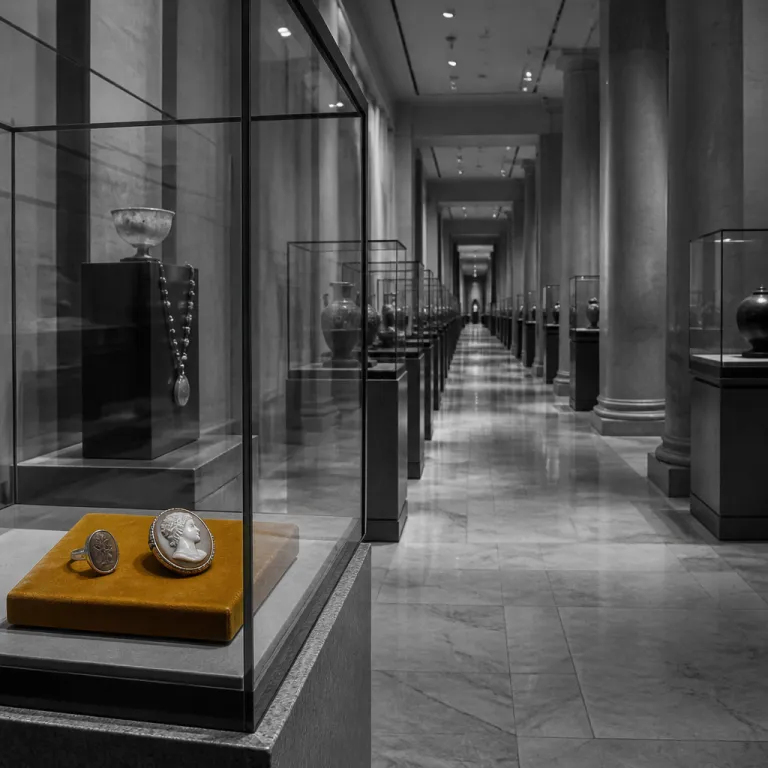
The new classical revival in intaglio and cameo jewelry collecting
Classical revival intaglio and cameo jewelry has shifted from niche curiosity to serious connoisseur territory. Collectors now treat each carved gem, whether a Roman intaglio or a shell cameo, as a portable fragment of ancient cultural memory rather than a quaint accessory. This change in attitude helps explain why a single gold cameo ring or a modest cameo brooch can now command more attention at auction than a larger but generic diamond jewel; for instance, a 1st–2nd century Roman carnelian intaglio ring at Bonhams London in 2023 more than doubled its estimate, while comparable modern diamond pieces sold on target.
Taste has always moved in cycles, and every few decades the market returns to Greek, Roman, and neoclassical motifs in both cameos and intaglios. What distinguishes the current period is that buyers are less interested in costume nostalgia and more focused on engraved gems with verifiable links to Roman times, ancient Greece, or the Renaissance revival of classical art. Curators at institutions such as the British Museum and the Metropolitan Museum of Art have highlighted engraved gems in recent displays, and dealers like Wartski and S.J. Phillips report that clients increasingly ask for documented provenance. Instead of chasing mass-production trends, they are building tightly edited collections of antique cameos, intaglio jewelry, and signet rings that read like a miniature museum of classical portraiture.
For a seasoned jewelry owner, this renewed interest offers a way to rebalance a collection that may lean heavily on modern diamonds and colored gems. A single hand-carved shell cameo pendant or a brooch pendant set with a sardonyx intaglio can introduce narrative depth and historical context among contemporary pieces. As one London-based specialist puts it, “A good Roman intaglio ring tells you more about its first owner than a dozen anonymous diamonds.” The result is a collection that feels less like a safe-deposit box of interchangeable gems and more like a curated group of personal art cameo choices, where value lies in the figure, the carving, and the story as much as in the carat weight.
From ancient seals to victorian cameos: how history shapes value
Every serious approach to classical intaglio and cameo jewelry begins with history, because age and context shape both aesthetics and price. The earliest intaglios were carved gems used as seals in ancient administrative systems, with the recessed carving pressed into wax to authenticate documents. Those tiny images of a deity, ruler, or mythological figure were not art jewelry in the modern sense, yet they laid the groundwork for later cameo jewelry and signet rings.
By Roman times, intaglio jewelry in carnelian, agate, and glass had become a status language, while raised-relief cameos carved from layered stones or shell appeared on rings, pendants, and personal ornaments. In ancient Greece, engraved gem cutters refined the classical proportions of the human figure, creating carved gems whose profiles still define what we consider an idealized Roman or Greek portrait. Centuries later, the Renaissance revived this taste for antique gems, and collectors commissioned new cameos and intaglios that imitated or reinterpreted ancient models, blurring the line between original and homage.
The Victorian era added another layer, with shell cameos and glass cameos produced in both hand-carved and semi-industrial ways, ranging from exquisite art cameo masterpieces to more commercial mass production. Antique cameos from this late-century period can still offer strong value, especially when the carving is crisp and the shell is thick and evenly colored. When you evaluate a cameo brooch or cameo pendant from this era, you are weighing not only the gold cameo frame and the quality of the shell cameos, but also how convincingly the piece channels the authority of much earlier antique jewelry traditions and classical motifs; this is the same logic that underpins specialist catalog notes and Victorian shell cameo valuation reports at major auction houses.
Intaglio versus cameo: reading the carving, stone, and setting
Understanding the technical difference between an intaglio and a cameo is essential if you want collecting in this field to feel intentional rather than accidental. An intaglio is a gem where the image is carved into the surface, creating a recessed design that can function as a seal, while a cameo is carved in relief, with the figure raised above its background. Both rely on the same core skills of carving, but they present very differently in jewelry and demand different ways of judging quality.
With intaglios, look first at the depth and precision of the carving in the gem, whether it is carnelian, sard, agate, or glass paste imitating ancient gems. Fine antique intaglios from Roman times or the Renaissance period often show hair, drapery, and facial features rendered with astonishing subtlety, even when the gem is only 10 millimetres long. Modern intaglio jewelry can be equally sharp, but the lines tend to be cleaner and less worn, so you must learn to distinguish genuine age from artificially distressed surfaces and from later post-classical reproductions. When photographing a Roman carnelian intaglio for documentation, use image alt text such as “close-up of Roman carnelian intaglio ring showing recessed profile and tool marks” so that the carving details are clearly described for digital catalogues.
Cameos, especially shell cameos and stone cameos carved from sardonyx or layered agate, ask you to read both the figure and the layers of color. In a strong art cameo, the carver uses the pale upper layer for the portrait and the darker ground for contrast, creating a sculptural effect that feels almost three-dimensional in a brooch pendant or cameo pendant. When you compare cameos carved by hand to those produced through partial mass production, you will notice that hand-carved examples have undercut details, crisp profiles, and a sense of life in the eyes that machine-assisted carving rarely achieves, which is why seasoned collectors often pay a premium for carved gems that clearly show the human hand.
Materials, motifs, and modern reinterpretations in collectors’ pieces
Material hierarchy matters in classical revival intaglio and cameo jewelry, because the stone or shell determines both visual impact and long-term durability. Carnelian and sard are workhorses for intaglios, offering a rich reddish brown that flatters yellow gold and makes Roman and Greek profiles glow with warmth. Agate and sardonyx, with their layered structure, are ideal for cameos carved in relief, allowing the figure to stand out in creamy white against a darker ground in a gold cameo ring, brooch, or pendant.
Shell, by contrast, gives a softer, more romantic look to cameo jewelry, especially in Victorian-era shell cameos where the carving often shows mythological scenes or allegorical female figures. These shell cameos are lighter in weight and more vulnerable to damage than hard-stone carved gems, so they reward careful storage and gentle wear, yet their translucency can be enchanting when light passes through the shell. Glass cameos and glass intaglios, whether antique or later post-classical reproductions, occupy an interesting middle ground, offering the look of carved gems at a lower cost while still carrying strong art and design value when the carving is crisp.
Contemporary designers are reinterpreting these materials and motifs rather than simply copying antique cameos or Roman intaglios. You see signet rings with minimalist intaglio designs, laurel-wreath borders, or abstracted classical profiles, often paired with mixed metals that echo ancient Greece and Roman times without feeling like costume. For collectors who already appreciate ancient metalwork traditions, it is worth exploring how these carved and engraved surfaces relate to techniques such as Persian naqsh or Japanese mokume gane, because the same eye for surface, line, and patina will serve you well when judging both cameos, intaglios, and more abstract gold work.
Building and authenticating a focused classical revival collection
For a jewelry owner transitioning into serious classical revival collecting, the first discipline is editing, not accumulation. Decide whether your core interest lies in antique cameos from the Victorian era, earlier Roman intaglios, or modern art cameo interpretations, then let that focus guide your acquisitions. A small group of carved gems that share a coherent theme, such as imperial Roman figure portraits or mythological scenes from ancient Greece, will always feel more powerful than a drawer of unrelated shell cameos and glass trinkets.
Authentication is the second discipline, because the market is rich in later copies, post-classical revivals, and outright modern fakes. Genuine antique intaglios from Roman times or the Renaissance period show specific wear patterns, tool marks, and gemstone aging that differ from late-century reproductions, and a good dealer will explain these details rather than hiding behind vague terms like "Roman style". When you examine a cameo brooch or brooch pendant, pay attention to the mounting style, hinge construction, and gold alloy, since a supposedly early piece set in a clearly modern frame should prompt questions about whether the carving and the setting truly belong to the same century.
Quick authentication checklist (for reference images and loupe work): look for softened high points on noses and hair, tiny chips on the highest relief, and tool marks that run with the design rather than across it; check whether the patina of the metal matches the apparent age of the carving; and compare hinge, clasp, and shank construction with documented period examples. Provenance and documentation matter, but so does how the piece fits into your broader narrative of jewelry and personal symbolism. Some collectors pair classical intaglio jewelry and signet rings with other heritage-rich pieces, such as refined religious bracelets that express faith and style, creating a dialogue between sacred motifs and secular classical art. In the end, the most satisfying collections are not the largest or the most expensive, but the ones where every carved shell, every carved gem, and every gold cameo feels chosen with intent, proving that in fine jewelry it is not the carat count, but the fire in the stone.
Where to buy, how to wear, and how to care
Finding strong pieces for a classical revival intaglio and cameo collection requires a mix of patience and strategic sourcing. Estate jewelers and specialist auction houses remain the best hunting grounds for antique cameos, Roman intaglios, and Victorian-era shell cameos with serious carving. Well-curated online dealers can also be valuable, but only when they provide clear images of the carving, the gem or shell, and the jewelry construction from every angle.
When you buy, think about how the piece will live in your wardrobe, not just in a safe. A cameo pendant on a long chain can soften a sharply tailored jacket, while a gold cameo ring or intaglio signet rings can anchor a stack of contemporary bands with a single classical figure. Cameo jewelry and intaglio jewelry also layer beautifully with other heritage-driven pieces, such as handcrafted bracelets that emphasize heritage and artistry, creating a quiet conversation between different cultures and periods on the same wrist or neckline.
Caring for these pieces is straightforward but non-negotiable if you want your carved and hand-carved treasures to age gracefully. Keep shell cameos away from harsh chemicals and prolonged dryness, since shell is organic and can become brittle, while hard-stone carved gems and glass intaglios mainly need protection from sharp blows and poor storage. Store each cameo brooch, brooch pendant, or ring separately in a soft-lined box, and remember that while mass-production jewelry can tolerate rough treatment, a finely carved gem from any century deserves the same respect you would give to a small, irreplaceable work of art.
FAQ
How can I tell if a cameo or intaglio is genuinely antique rather than a modern reproduction ?
Age reveals itself through a combination of carving style, wear patterns, and metalwork details. Antique cameos and intaglios often show slightly softened high points, old-style hinges or clasps, and hand-finished gold work that differs from modern mass production. When in doubt, consult a specialist who can compare your piece to documented examples from Roman times, the Renaissance, or the Victorian era.
Are shell cameos less valuable than hard stone cameos and carved gems ?
Shell cameos are generally less durable than hard-stone carved gems, but value depends more on artistry, age, and subject than on material alone. A finely carved Victorian shell cameo with a complex mythological scene can be more desirable than a mediocre stone cameo with weak carving. Collectors should judge each piece on the quality of the figure, the depth of the carving, and the overall condition of the jewelry.
What makes roman intaglio rings and signet rings so sought after by collectors ?
Roman intaglio rings and signet rings combine historical significance with daily wearability, which is rare in ancient jewelry. Each recessed carving once functioned as a personal seal, so the gem often carries a specific identity, deity, or emblem tied to Roman society. That blend of intimate history and strong design explains why these intaglios sit at the center of many classical revival collections and feature prominently in Roman carnelian intaglio auction prices.
Can modern classical revival pieces hold their value alongside true antiques ?
Well-designed modern classical revival pieces can hold value when they show clear craftsmanship, thoughtful use of materials, and a distinct design voice rather than copying antique cameos or intaglios. Collectors often treat these as future heirlooms, especially when the maker is documented and the carving is clearly hand executed. While they may not match the premiums of rare Roman or Renaissance gems, they can still become important anchors in a contemporary collection.
How should I integrate classical revival pieces into an existing fine jewelry collection ?
The most effective approach is to treat each cameo or intaglio as a narrative focal point rather than an isolated curiosity. Pair a gold cameo ring with modern diamond bands, or frame a carved gem pendant with minimalist chains to let the carving read clearly. Over time, these classical motifs will give your collection a sense of depth and continuity that pure gemstone pieces often lack.