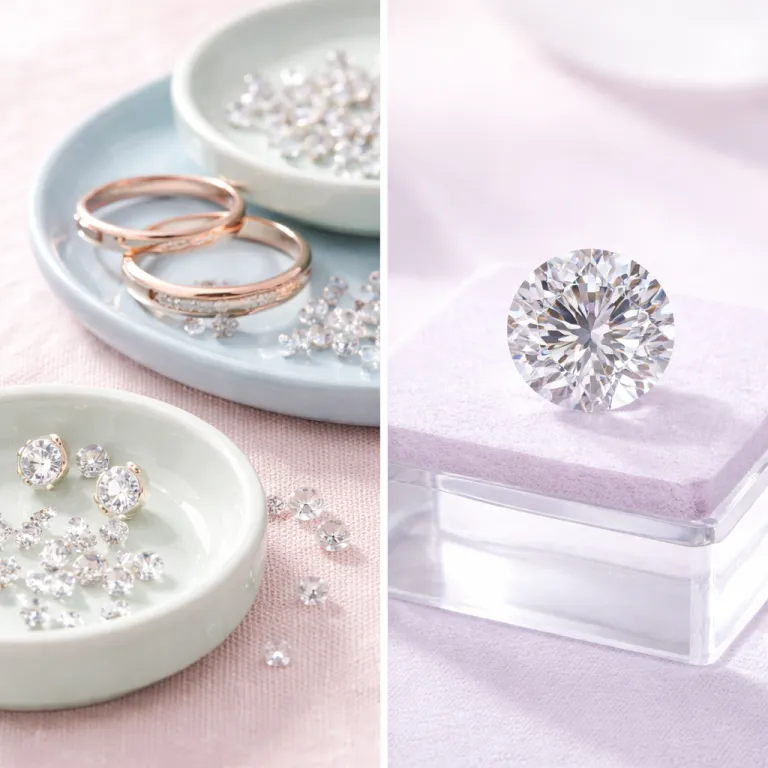
Diamond market bifurcation and why your playbook is now obsolete
The phrase diamond market bifurcation 2026 describes a split that is already visible in every serious diamond market conversation. On one side sit natural diamonds behaving like a finite asset class with their own market forecast, while on the other side lab grown diamonds function as a fast moving design material whose prices track technology rather than geology. Treating both products as one homogeneous market is now the quickest way to misread risk, misprice opportunity, and misunderstand where real long term jewelry value will concentrate.
Look at the data from the global diamond trade and you see two curves, not one, even though headline reports still talk about the diamond industry as if it were a single organism. Natural diamonds at the trophy level — think a 5 carat D flawless emerald cut from a respected mine with documented supply chain provenance — continue to clear at Sotheby's and Christie's with healthy growth, while commercial lab grown stones see wholesale prices fall by double digits year on year. This is not a temporary dislocation in the diamond market ; it is structural market bifurcation between a scarcity backed natural diamond asset and a scalable grown diamond product.
For a fine jewelry owner, the practical implication is simple yet uncomfortable. You can no longer assume that every diamond, regardless of size or origin, will gently appreciate as long as global diamond demand and the wider luxury industry grow. Instead, you must decide whether each piece in your jewelry box belongs to the investment side of the diamond industry or to the aesthetic, high rotation side where consumer tastes, lab technology, and fashion cycles dominate prices.
Natural diamonds now behave like a tiered market within the broader global diamond ecosystem. At the top, rare gem diamonds with exceptional carat weight, pedigree, and sometimes fancy colored saturation command increasing market share of auction attention, while mid market 0.5 to 2 carat stones without special characteristics face pressure from both lab grown and colored stones. In parallel, lab grown diamonds have created a new market for large size looks at accessible price points, but that same growth in supply has undermined any credible investment thesis for a grown diamond beyond its emotional and design value.
When you hear that diamond prices are soft, ask which segment and which product, because the answer now depends on whether we are talking about a natural diamond from a constrained rough diamond pipeline or a lab grown stone produced in an industrial lab cluster. The diamond market bifurcation 2026 narrative is really about two supply chains with opposite economics, one limited by geology and capital intensive mining, the other driven by energy costs, reactors, and rapid capacity expansion. As a result, the same carat size on your finger can sit on either side of the investment line depending on whether it is a natural or a grown diamond.
Regional dynamics reinforce this split, especially between north america and the middle east, where consumer expectations diverge sharply. In north america, lab grown jewelry has captured meaningful market share in bridal and fashion categories, while ultra high net worth buyers still chase rare natural diamonds and fancy colored stones at auction. In the middle east, cultural preference for natural diamonds and visible status keeps demand for large natural stones resilient, even as some younger buyers experiment with lab grown for secondary pieces.
For investors who track the diamond market forecast from firms such as Bain and De Beers, the message is consistent even when the language is cautious. Structural constraints on new natural diamonds supply, combined with the depletion of certain rough diamond sources, support the scarcity thesis at the top end, while exponential lab capacity growth caps long term price potential for grown diamonds. The diamond market bifurcation 2026 framework simply makes explicit what the data has been whispering for several seasons.
Even individual corporate stories illustrate this divergence inside the diamond industry. A miner such as Lucara Diamond, known for exceptional rough diamond recoveries from the Karowe mine, lives or dies on a handful of large natural stones, while a retailer like Signet Jewelers now manages separate merchandising and pricing strategies for natural diamonds and lab grown alternatives. When you evaluate your own jewelry, you should apply the same dual lens, asking whether each diamond is priced like a finite asset or like a manufactured product whose price will track the cost curve of the lab that grew it.
Two products, two emotional jobs: how to use each side of the split
Once you accept that diamond market bifurcation 2026 is structural, the next step is to assign different emotional jobs to natural diamonds and lab grown stones. Natural diamonds excel when the story matters as much as the sparkle, whether that story is a family milestone, a specific mine origin, or a piece of jewelry designed to cross generations. Lab grown diamonds, by contrast, shine when you want bold size, experimental design, and the freedom to play without worrying about long term diamond prices or resale.
Think of a 1.5 carat natural diamond in a platinum solitaire versus a 3 carat lab grown oval in a sculptural yellow gold toi et moi setting, and you immediately feel the different roles. The natural diamond solitaire is a compact store of value whose price per carat reflects constrained rough diamond supply, brand reputation, and grading nuance, while the larger lab grown stone is a style statement whose price is anchored in the economics of the lab and the broader technology industry. Both are valid choices, but only one belongs in the same mental drawer as other alternative assets in your portfolio.
For many fine jewelry owners, the most effective strategy is to treat lab grown jewelry as a design laboratory and natural diamond pieces as the backbone of a long term collection. Use lab grown diamonds in multiple sizes and shapes — elongated cushions, shield cut side stones, dramatic pear shaped drops — to explore proportions and aesthetics that would be prohibitively expensive in natural diamonds of equivalent carat weight. Reserve your budget for natural diamonds when the piece marks a life event, anchors a suite, or reaches a carat size where scarcity and auction comparables begin to matter.
Retailers have already internalized this split, even if they rarely use the phrase market bifurcation in front of clients. Many chains, including Signet Jewelers in north america, now present parallel assortments where the same design exists in both natural and lab grown versions at very different prices, effectively letting the consumer choose between emotional permanence and aesthetic experimentation. Behind the scenes, their data teams track separate demand curves, margin profiles, and inventory risks for natural diamonds and grown diamonds, because the two products no longer move in lockstep.
For you, this means asking sharper questions at the counter about the origin, the supply chain, and the long term positioning of each diamond you consider. When a sales associate quotes a price for a 2 caratx lab grown stone, you should mentally compare it not only to natural diamond prices today but also to the likely price compression as lab capacity expands and market share for lab grown increases. When you evaluate a 2 carat natural diamond, you should instead focus on cut quality, rarity of color and clarity combination, and whether the stone sits above or below the thresholds where auction houses actively court consignments.
Support services for fine jewelry owners are also adapting to this bifurcated landscape. Platforms that help you navigate a competitive market for resale, insurance, and documentation, such as those described in this analysis of how specialized advisors support fine jewelry owners in a competitive market, increasingly differentiate between natural diamond and lab grown value trajectories. Appraisals for natural diamonds lean on auction comparables and constrained supply forecasts, while lab grown valuations emphasize replacement cost and current retail prices rather than any expectation of future growth.
Ethical and environmental narratives intersect with this split but do not erase the underlying economics. Some consumers prefer lab grown diamonds because the idea of a controlled lab environment feels cleaner than open pit mining, while others prioritize natural diamonds with verified responsible sourcing from mine to setting, supported by transparent supply chain documentation. If responsible luxury is a priority, you should evaluate both natural and grown options using rigorous sourcing frameworks, such as those outlined in independent guides to verifying ethical sourcing claims, rather than relying on simplistic lab versus natural marketing slogans.
Ultimately, the emotional job of a natural diamond is to carry memory, meaning, and a credible link to scarcity, while the emotional job of a grown diamond is to deliver spectacle, scale, and creative freedom at a manageable price. When you align each purchase with its proper role in your life and in the broader diamond market, you stop expecting a lab grown cocktail ring to behave like a financial instrument and stop treating a rare natural diamond as if it were a disposable fashion accessory. That clarity is the quiet luxury in a noisy diamond industry.
Where value concentrates now: auctions, colored stones, and the vulnerable middle
The most telling evidence for diamond market bifurcation 2026 comes from the top of the market, where data is public and brutally honest. Sotheby's and Christie's have reported double digit growth in luxury sales, driven by trophy tier natural diamonds, rare fancy colored stones, and signed jewelry from maisons such as Cartier, Van Cleef & Arpels, and Harry Winston. While unit volumes may be modest, the prices achieved for exceptional gem diamonds confirm that scarcity backed natural stones still command intense global diamond demand.
Contrast that with the experience of many retail jewelers in north america, who describe a price up, units down year in their core bridal and fashion categories. Average ticket values rose as consumers traded into larger lab grown stones or higher quality natural diamonds, but overall volumes softened, especially in the mid market 0.5 to 2 carat range where lab grown competition is fiercest. This is the vulnerable middle of the diamond market, where stones are too common to be auction darlings yet too expensive to be treated as disposable jewelry.
If you own several natural diamonds in that 0.5 to 2 carat band, particularly in commercial grades, you should recalibrate expectations about future growth. These stones may hold sentimental value and remain beautiful to wear, but their resale prospects are challenged by the flood of lab grown alternatives offering larger size at lower price per carat. In a bifurcated diamond industry, the market share of appreciation shifts upward to stones above roughly 3 carats, to rare fancy colored diamonds, and increasingly to high quality colored gemstones.
Colored stones deserve special attention in any discussion of investment oriented jewelry strategy. Zambian emeralds, fine unheated Burmese rubies, and Kashmir or royal blue Sri Lankan sapphires have shown robust price growth in recent auction seasons, reinforcing the broader scarcity thesis that underpins the high end of the global diamond and gemstone market. For ultra high net worth collectors, reallocating some capital from mid market natural diamonds into top tier colored stones has become a rational response to diamond market bifurcation 2026.
Specialist miners and brands illustrate how tightly value is now linked to rarity and narrative. Lucara Diamond, for example, built its reputation on recovering exceptionally large rough diamond crystals from a single Botswana deposit, while Gem Diamonds has focused on high value stones from its Letseng mine in Lesotho, both operating in a segment where each carat can dramatically influence company fortunes. At the retail end, Signet Jewelers and other large chains must sell thousands of smaller natural diamonds and lab grown stones to match the value created by a single record breaking fancy colored diamond at auction.
For a sophisticated jewelry owner, the logical response is to concentrate natural diamond exposure where scarcity is most defensible. That usually means natural diamonds above 3 carats with excellent cut, strong color and clarity, and ideally some combination of origin story, design pedigree, or fancy colored appeal that sets them apart from generic inventory. Below that threshold, it often makes more sense to treat diamonds as wearable luxury rather than as a core investment, unless the stone has unusual characteristics or sits within an iconic signed jewel.
Colored gemstone strategy deserves equal rigor, especially as more ultra wealthy investors quietly move into colored gemstones as a complement to their diamond holdings. Detailed guides on why ultra wealthy investors are quietly moving into colored gemstones emphasize the importance of origin, treatment status, and certification, which mirror the factors that drive value in high end natural diamonds. In both cases, the market rewards stones that combine beauty, rarity, and impeccable documentation, while punishing those that are merely large or heavily treated.
In this context, diamond market bifurcation 2026 is less a crisis than a sorting mechanism that pushes capital toward genuinely rare assets and away from mass produced sparkle. The mid market may feel squeezed as lab grown stones undercut commercial natural diamonds on size and price, but collectors who pivot toward trophy tier natural diamonds and top colored stones can still build collections with credible long term value. In a bifurcated market, the safest place to stand is either at the very top of the natural pyramid or comfortably in the design driven, lab grown playground — not stranded in the eroding middle.
Portfolio strategy for collectors: from carat counting to narrative and scarcity
Accepting diamond market bifurcation 2026 as permanent forces a more disciplined portfolio strategy for serious jewelry owners. You are no longer buying generic exposure to the diamond market ; you are choosing between two distinct assets, one tied to geological scarcity and one tied to technological scalability. That choice should shape not only what you acquire next but also how you care for, insure, and potentially rebalance the jewelry you already own.
Start by inventorying your collection through the lens of origin, size, and narrative rather than just total carat weight. Separate natural diamonds from lab grown stones, then group natural diamonds by carat band — under 0.5 carat, 0.5 to 2 carats, 2 to 3 carats, and above 3 carats — and by whether they have any special attributes such as fancy colored hues, old cut charm, or signed settings. This exercise reveals where your exposure lies in the vulnerable mid market and where you may already own pieces that align with the scarcity backed segment of the diamond industry.
Next, assign each piece a role in your broader financial and emotional portfolio. A 4 carat natural diamond with excellent cut and strong grading, perhaps mounted in a timeless three stone ring, might be treated as a quasi financial asset whose price you track against auction data and market forecast reports from major consultancies. A 3 carat lab grown pear shaped diamond in a bold contemporary pendant, by contrast, belongs firmly in the lifestyle bucket, where its value is measured in wear, joy, and design impact rather than in any expectation of future price appreciation.
When considering new acquisitions, let scarcity and story guide your natural diamond purchases and let creativity guide your lab grown choices. For natural diamonds, prioritize stones with verifiable supply chain documentation, strong grading from reputable laboratories, and characteristics that would interest a future collector, not just a future consumer. For lab grown diamonds, focus on how the stone's size, shape, and setting expand your jewelry wardrobe, accepting that the price you pay reflects current technology and demand rather than any durable floor in the global diamond market.
Risk management also changes in a bifurcated diamond market, especially around liquidity and exit options. Natural diamonds with exceptional qualities, particularly those above 3 carats or with fancy colored saturation, can often find buyers through auction houses, specialist dealers, or private sales networks, though transaction costs and timelines vary. Lab grown diamonds, however, currently have limited secondary market infrastructure, and their prices are vulnerable to further declines as grown diamonds production scales and market share shifts.
Ethical considerations should be integrated into this strategy rather than treated as an afterthought. Whether you favor natural diamonds or lab grown stones, insist on transparent information about origin, environmental impact, and labor practices, using independent frameworks for responsible luxury to interrogate sourcing claims. Guides that explain how to verify ethical sourcing claims from mine to setting can help you separate substantive supply chain efforts from marketing language, which matters for both your conscience and the long term desirability of your pieces.
Looking ahead, several factors could influence the contours of diamond market bifurcation without erasing it. New mine discoveries, changes in mining policy, or breakthroughs in lab technology could shift the balance of supply, while evolving consumer attitudes in north america, the middle east, and emerging luxury markets could alter demand patterns for natural diamonds and lab grown stones. Yet the fundamental distinction between a finite natural resource and a scalable lab product will remain, anchoring the structural split between investment grade natural diamonds and design forward grown diamonds.
For the seasoned collector, the guiding principle is simple but demanding. Build your natural diamond and colored stone holdings around pieces whose rarity, documentation, and narrative would still matter to a sophisticated buyer a generation from now, and treat your lab grown jewelry as the beautifully crafted, high impact wardrobe it is. In a world defined by diamond market bifurcation 2026, the enduring luxury is not the carat count, but the fire in the stone.
Key figures shaping the bifurcated diamond landscape
- Major consultancies and industry leaders report that ultra high end natural diamonds and fancy colored stones continue to achieve strong prices at auction, with leading houses such as Sotheby's and Christie's recording double digit percentage growth in luxury sales in the most recent reported year, underscoring the resilience of the trophy tier segment.
- Trade publications covering the north america jewelry market describe a recent period as a price up, units down year, where average transaction values increased but overall unit sales declined, reflecting consumers trading into larger lab grown stones or higher quality natural diamonds while buying fewer pieces overall.
- Industry analyses of lab grown diamonds indicate wholesale price declines in the mid teens to around twenty percent over a recent twelve month period, highlighting how rapid capacity expansion in labs and growing market share for grown diamonds exert downward pressure on prices even as consumer awareness rises.
- Reports on colored gemstone markets show Zambian emerald prices increasing by roughly twenty five to thirty percent over a comparable multi year window, reinforcing the thesis that scarcity backed colored stones can outpace broad commercial natural diamonds in terms of investment performance.
- Public disclosures from miners such as Lucara Diamond and Gem Diamonds demonstrate how a small number of large rough diamond recoveries can account for a disproportionate share of revenue in a given year, illustrating the extreme concentration of value at the top of the natural diamond industry.
- Retail data from large chains like Signet Jewelers confirm that lab grown diamonds now represent a significant and growing portion of bridal and fashion jewelry sales in north america, even as natural diamonds remain central to high end and milestone pieces, exemplifying the practical reality of diamond market bifurcation 2026 at the consumer level.
